Whole Health Approach
Health services are central to achieving the ambitions of the Government’s Violence Against Women and Girls Strategy. This article explores why a whole health response, specialist leadership and coordinated pathways to safety are essential for victims and survivors.
While domestic abuse and sexual violence have often been viewed as issues for specialist services and the criminal justice system, the ambitions set out in the Government’s Tackling Violence Against Women and Girls Strategy reinforce the vital role that health services play in identifying abuse, responding safely and supporting recovery. Domestic abuse is a public health emergency. Embedding a consistent, national health response is essential to delivering the Freedom from Abuse (VAWG) Strategy and the NHS 10‑Year Plan.
For many victims and survivors, healthcare settings are among the few places where they may come into contact with a professional outside of the home. Whether attending a GP appointment, maternity services, mental health support, emergency care, sexual health services or community health provision, these interactions can present critical opportunities to identify abuse, offer support and connect individuals with specialist services. Without a coordinated whole health approach victims will remain invisible.
No Wrong Front Door
One of the most significant references made repeatedly in relation to health policy on domestic and sexual abuse is the principle that there should be “no wrong front door” for victims and survivors seeking support. Access to safety should not depend on whether someone speaks to the right professional, attends the right service or discloses abuse in the right setting. Every part of the health system has a role to play.
The Government’s VAWG and Domestic Abuse strategies recognise that healthcare professionals are uniquely placed to identify indicators of abuse, initiate safe conversations and facilitate access to specialist support. This reflects growing evidence that victims and survivors may access health services for years before disclosing abuse, often presenting with physical injuries, chronic health conditions, poor mental health, substance use issues, reproductive health concerns or unexplained symptoms linked to trauma.
A whole health response therefore requires more than awareness and siloed projects. It requires systems, pathways, leadership and accountability that ensure every contact counts and that staff are confident in what to do when abuse is identified.
Delivering on the Health Ambitions of the VAWG Strategy
The health commitments within the VAWG Strategy emphasise the need for improved identification, early intervention, workforce development, trauma-informed practice and stronger connections between healthcare services and specialist domestic abuse provision.
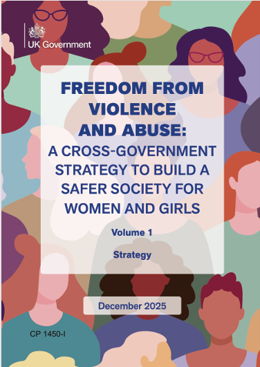
Whilst we are now seeing progress with the first phase of Steps to Safety roll out, including the announcement of the initial 12 ICB’s (Integrated Care Boards) and announcements about National Support Partner and National Evaluation Partners, there are many actions across the health response to ensure the ambitions of the VAWG strategy and NHS 10 year plan are fully realised.
STADA’s Contribution to a Whole Health Response
Translating national ambition into local delivery is one of the most significant challenges facing health systems. While policy direction is increasingly clear, organisations require practical mechanisms to embed change, build workforce confidence and create sustainable pathways to specialist support.
For many years STADA has worked alongside NHS organisations, Integrated Care Systems, private healthcare providers, commissioners and specialist services to strengthen domestic abuse and sexual violence responses across healthcare settings.
Central to this work is our commitment to trauma-informed practice and coordinated community responses. We know that victims and survivors benefit most when professionals understand the impact of trauma, respond compassionately and are connected into wider systems of support. Equally, we know that healthcare organisations achieve better outcomes when domestic abuse and sexual violence is recognised as a whole-system issue rather than the responsibility of a single team or service.
The Critical Role of Domestic Abuse / Sexual Violence Coordinators
If there is one lesson consistently emerging from health-based domestic abuse initiatives, it is the importance of dedicated coordination and leadership. Effective responses are rarely achieved through training alone. They require individuals who can oversee implementation, build partnerships, maintain momentum and ensure accountability. Our work on Health Pathfinder Programme and Crossing Pathways Whole Health Project provides a strong evidence base for the value of domestic abuse and sexual violence coordinator roles.
Coordinator roles enable joined up and consistent methods for embedding policies, workforce development, referral pathways, processes for victims and survivors (both patients and staff) and responses to those causing harm. Coordinators facilitate the embedding of specialist services within neighbourhood health services, support effective multi-agency working, drive continuous improvement and disseminate best practice. They engage across the local health landscape, keeping up to date with changing availability of specialist independent service provision, and ensure robust collection and analysis of data.
These practitioners provide the bridge between policy and practice and champion a strategic response to domestic abuse and sexual violence across organisations.
Coordinators are often the people ensuring that domestic abuse and sexual violence remain visible within competing healthcare priorities. They provide expertise, consistency and leadership at a time when health systems are increasingly focused on prevention, inequalities and competing health system demands. Both the Health Pathfinder project and
Crossing Pathways Whole Health pilots identified that embedding specialist roles within health leads to increased referrals to specialist domestic abuse services and other pathways such as MARAC.
As health systems continue to develop their response to VAWG, investment in these roles remains essential. Without dedicated leadership, there is a risk that progress becomes dependent upon individual enthusiasm rather than embedded organisational commitment
Pathways to Safety: Embedding Excellence Across Health Services
Our Pathways to Safety Accreditation Programme has been developed to help health providers translate ambition into action.
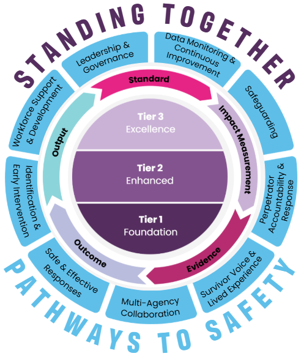
The programme provides a structured framework for assessing and strengthening domestic abuse and sexual violence responses across healthcare providers. It supports services to evaluate leadership, governance, workforce capability, referral pathways, partnership working and survivor-centred practice against recognised standards.
Importantly, accreditation is not simply about achieving recognition. It is about creating meaningful and measurable improvements for victims and survivors. By embedding consistent standards and promoting continuous improvement, the programme helps health create safer and more effective responses to domestic abuse.
In many ways, Pathways to Safety represents the practical delivery of the “no wrong front door” principle. It seeks to ensure that wherever a victim or survivor is seen within a health system, they encounter professionals who are equipped to respond, pathways that are clear and accessible, and services that place safety, dignity and choice at the centre of care.
Looking Ahead
As we mark the 16 Days of Activism, it is important to celebrate the progress that has been made across health systems while recognising that significant work remains.
The challenge now is not whether health services should respond to violence against women and girls. That question has already been answered. The challenge is ensuring every part of the health system has the leadership, workforce capability and pathways required to respond consistently and effectively.
If the ambitions of the VAWG Strategy and NHS 10-Year Plan are to be realised, investment in trauma-informed practice, specialist leadership, coordinated pathways and workforce development must remain a priority.
Because when there is truly no wrong front door, victims and survivors are more likely to find safety, support and recovery when they need it most.
To find out more about STADA’s work in health, including our Crossing Pathways regional meetings, the Health and Domestic Abuse Leadership group (HDALG), the Inter-Collegiate and Agency Domestic Violence Abuse (INCADVA) forum, or our Pathways to Safety accreditation programme please contact us at health@standingtogether.org.uk.