Standing Together Against Domestic Abuse brings communities together to end domestic abuse.
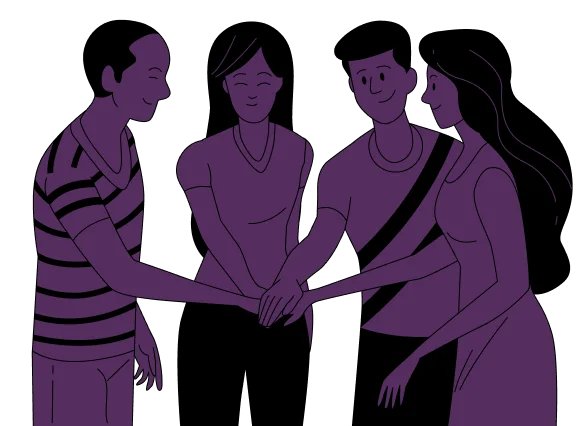

Standing Together is a national charity bringing communities together to end domestic abuse.
We bring local services together to keep people safe.
Most public services weren’t designed with domestic abuse in mind, and they often struggle to keep people safe. Poor communication and gaps between services put survivors at risk. Standing Together aims to end domestic abuse by changing how local areas respond to it. We do this through an approach that we pioneered, called the Coordinated Community Response (CCR).
The Coordinated Community Response brings services together to ensure local systems truly keep survivors safe, hold abusers to account, and prevent domestic abuse. Our model of a coordinated local partnership to tackle and ultimately prevent domestic abuse is now widely accepted as best practice.
We also deliver training to a range of professionals, including criminal justice partners, police, health professionals, housing associations, MARACs, social services, local authorities and faith groups. If you are interested in learning more about our training, see our training page.
We began as a pilot project in the London borough of Hammersmith and Fulham originally focusing on the local criminal justice response. However, over the years, the charity has grown to encompass all services and parts of the community that DA survivors may access, including settings like health, social care, housing, criminal justice, and local communities.
Operating nationally, Standing Together’s aim is to stop DA survivors from falling through gaps in services. We do this by ensuring a Coordinated Community Response (CCR) to domestic abuse, which brings together voluntary and statutory organisations to work in partnership with each other to improve responses for DA victim-survivors.
The CCR model which we pioneered, and which is now recognised as a model of best practice in the UK to end domestic abuse, plays a key role in strengthening the civil society as whole.

Our Theory of Change is conceptually simple, although complex to deliver – apply the Coordinated Community Response (CCR) effectively and engage with Survivor Voices meaningfully to end the causes and consequences of domestic abuse for good.
Transforming systems takes time, and Standing Together is uniquely positioned to drive the required changes through its extensive corporate memory of the CCR model and how this can be applied to achieve the goal.